
Florida Amendment 3 Passed: What Southwest Florida Homeowners Need to Know
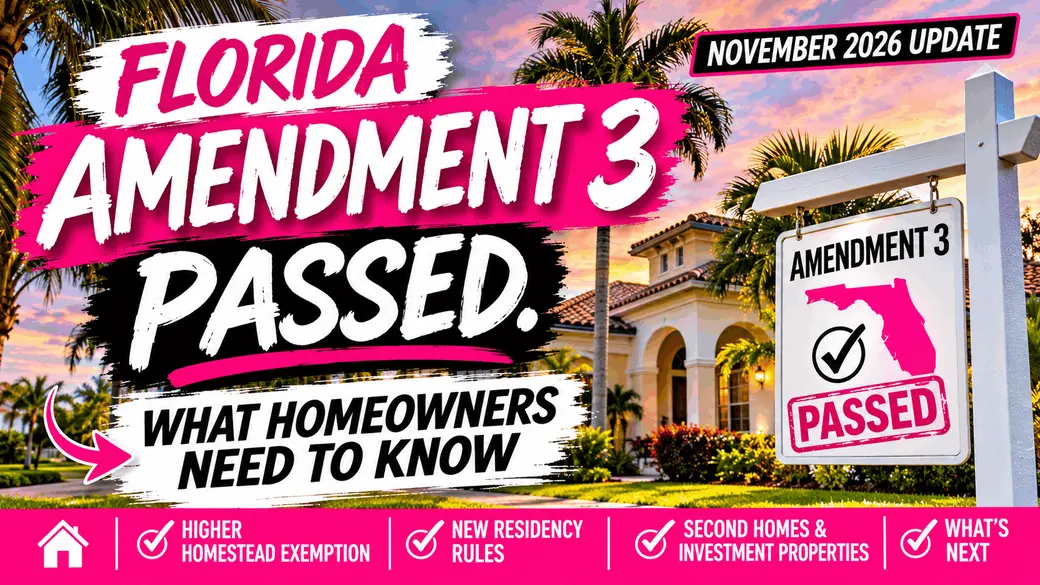

November 4, 2026 | Southwest Florida Real Estate Update
Florida voters approved Amendment 3 in the November 3, 2026 general election, according to unofficial election results showing approximately 62% support. That's above the 60% required to amend Florida's Constitution.
And yes, this is a significant change for Florida homeowners.
But before the headlines, social media posts, and neighborhood conversations get ahead of the facts, let's break down what actually passed.
First things first: Florida did NOT eliminate property taxes.
Amendment 3 changes homestead exemptions, property assessment limits, and certain rules affecting local government revenue.
Here's what homeowners, buyers, sellers, and investors in Southwest Florida need to understand.
1. The Homestead Exemption Is Increasing
For qualifying primary residences, Amendment 3 increases the homestead exemption applicable to non-school property taxes.
Here's the timeline:
-
2027: The exemption increases to $150,000.
-
2028: The exemption increases to $250,000.
-
2029 and beyond: The increased exemption is adjusted for inflation.
What does that mean?
A larger portion of a qualifying home's assessed value may be exempt from certain property taxes.
For example, a qualifying homeowner with an assessed property value of $400,000 could potentially have $250,000 of that value exempt from applicable non-school property taxes in 2028.
That does not mean the homeowner receives $250,000.
And it certainly doesn't mean everyone will save the same amount.
Actual savings depend on assessed value, eligibility, local millage rates, and other applicable tax rules.
2. School Property Taxes Are Still Here
This is probably the most important clarification.
The increased exemption does not apply to school district property taxes.
Those taxes remain subject to their applicable rules.
Other assessments and charges may also remain on your annual property tax bill.
So if someone tells you Florida just eliminated property taxes for homeowners, that's not accurate.
Even homeowners who qualify for the expanded exemption may still have property taxes and assessments to pay.
3. There's a Catch for People Moving to Florida
This one is particularly important for Southwest Florida.
Amendment 3 establishes different eligibility rules based on Florida residency.
If you're a Florida resident on December 31, 2026:
You may qualify for the expanded homestead exemption beginning in 2027, provided you meet the applicable homestead requirements.
If you're not a Florida resident on December 31, 2026:
You can still qualify for the existing homestead exemption when eligible.
However, the expanded exemption generally does not begin until the fifth year of homestead exemption eligibility.
There are important qualifications.
The amendment makes this requirement subject to the U.S. Constitution. It also allows counties and municipalities to shorten the waiting period under specified conditions, including a two-thirds vote.
Additional implementation rules are expected from the Florida Legislature.
The takeaway for people relocating to Southwest Florida?
Don't assume that purchasing a home in 2027 automatically qualifies you for the same expanded exemption available to an eligible existing Florida resident.
Your residency date, homestead status, and applicable rules will matter.
4. What About Second Homes and Investment Properties?
The expanded homestead exemption is intended for qualifying primary residences.
It does not automatically apply to second homes, vacation properties, rentals, or commercial real estate.
However, Amendment 3 also changes the annual assessment increase limitation for qualifying non-homestead properties.
The cap decreases from 10% to 5%.
That means the annual increase in assessed value for applicable non-homestead property taxes is subject to a lower limit.
But here's where people need to pay attention.
A lower assessment increase cap is not the same thing as a guaranteed lower property tax bill.
Property taxes can still be affected by millage rates, changes in ownership, reassessment rules, and other factors.
For investors, second-home owners, and commercial property owners, this is worth reviewing with a qualified tax professional.
5. What Happens to Save Our Homes and Portability?
Amendment 3 does not eliminate Florida's existing Save Our Homes assessment limitation or homestead portability provisions.
Those protections remain relevant for homeowners considering selling one primary residence and purchasing another.
If you're downsizing, upgrading, or moving into new construction, don't assume the new exemption makes portability unnecessary.
Your existing assessed value, potential portability benefit, purchase price, and homestead eligibility may all affect your future property taxes.
Before making a move, get a property-specific estimate.
The seller's current tax bill is not necessarily what a buyer will pay after purchasing the property.
6. Could Florida Eventually Eliminate More Homestead Property Taxes?
Here's a provision that deserves attention.
Amendment 3 requires the Florida Legislature to establish a uniform procedure allowing counties and municipalities to increase the homestead exemption for their respective property tax levies, potentially up to the full assessed value of a qualifying homestead.
It also permits certain special districts to increase exemptions, subject to voter approval.
That does not mean those additional exemptions are automatically happening in 2027.
The Legislature must establish the procedures, and further decisions would be required.
No universal timeline for eliminating all applicable non-school homestead property taxes has been established by the amendment.
School district taxes are not eliminated by this provision.
7. What Could This Mean for Local Government Services?
Property taxes help fund local services and infrastructure.
Amendment 3 also establishes restrictions on how counties and municipalities may use property tax revenue, while allowing certain additional expenditures through the approval processes described in the amendment.
Supporters argue the changes will provide meaningful relief to homeowners facing rising housing costs.
Opponents have raised concerns about reduced local government revenue and potential consequences for services, infrastructure, and other funding needs.
Both the homeowner tax changes and local government funding questions deserve attention.
But here's what we cannot responsibly tell you today:
We cannot say exactly how Lee, Collier, Charlotte, or other Southwest Florida counties will adjust their budgets.
We cannot guarantee that fees will increase.
And we cannot claim that specific local services will be reduced.
Those outcomes will depend on implementation, future budgets, and decisions made by state and local officials.
8. Will Amendment 3 Affect Southwest Florida Home Values?
Property taxes are part of the overall cost of owning a home, so changes may influence how some buyers evaluate affordability.
But does that automatically mean home prices will increase?
No one can responsibly guarantee that.
Southwest Florida real estate is influenced by many factors, including:
-
Mortgage interest rates
-
Homeowners insurance costs
-
Housing inventory
-
Buyer demand
-
HOA and condominium expenses
-
Local economic conditions
-
Property-specific carrying costs
Amendment 3 is one piece of a much larger picture.
If you're buying, selling, or investing, avoid making decisions based on projected savings that haven't been verified for your particular property.
9. When Does Amendment 3 Take Effect?
The amendment takes effect January 1, 2027.
The first expanded homestead exemption is scheduled for 2027, followed by another increase in 2028.
However, several provisions require additional legislative or administrative implementation.
The Florida Legislature is expected to address those details, and county property appraisers will provide additional guidance as the rules are finalized.
The November 3 election results were still unofficial as of this November 4 update.
The reported approval exceeds the constitutional threshold, but final certification and implementation are separate steps.
What Should Southwest Florida Homeowners Do Right Now?
My advice?
Don't panic. Don't assume. And definitely don't start spending tax savings you haven't calculated yet.
If you own a home, review your current homestead exemption and assessed value.
If you're relocating to Florida, pay close attention to the residency requirements.
If you own investment property or a second home, understand how the revised assessment cap may apply.
If you're planning to sell and purchase another primary residence, review your Save Our Homes and portability considerations.
And if you have questions about your specific property tax situation, speak with your county property appraiser or a qualified tax professional.
Most importantly, do your own research.
Read the amendment itself.
Review official government resources.
And be cautious about social media posts promising specific savings or claiming that property taxes have been eliminated.
Here's Where You Can Get More Details
For the official amendment language, election information, and property-specific guidance, start with these resources:
Florida Department of State: Official Amendment 3 Language
https://constitutionalinitiatives.dos.fl.gov/Home/InitDetail?account=10&seqnum=110
Florida Chamber: Amendment 3 Information and Implementation Updates
https://www.flchamber.com/amendment3
Florida Department of Revenue: Property Tax Information
https://floridarevenue.com/property/
Lee County Property Appraiser
https://www.leepa.org/
Collier County Property Appraiser
https://www.collierappraiser.com/
Charlotte County Property Appraiser
https://www.ccappraiser.com/
More Information Is Coming
This is a developing change to Florida's property tax system, and there are still implementation details to work through.
More information will be coming as the Legislature, state agencies, and local property appraisers clarify how the new rules will be applied.
I'll continue sharing relevant updates for Southwest Florida homeowners, buyers, sellers, and investors as reliable information becomes available.
In the meantime, I encourage you to do your own research, review the official language, and avoid making financial decisions based solely on headlines.
Because understanding what passed is one thing.
Understanding what it actually means for YOUR property is what matters.
Stephanie Barrett
SWFL's Only Inked Agent™
Broker Associate | LPT Realty LLC
941-815-0201
inkedagentco@gmail.com
https://inkedagentflorida.com/
No Fluff. No Filters. Just Sold.
Disclaimer: This article provides general educational information based on the amendment language and information available November 4, 2026. It is not legal, tax, or financial advice. Individual eligibility and property tax consequences may vary. Election certification and further implementation guidance remain pending.
Categories
Recent Posts









GET MORE INFORMATION
